In the grand theater of Nigerian governance, where power is often measured by the volume of one’s voice or the size of a motorcade, there exists a profound exception in the “New World” of Jigawa State. Her Excellency, Hajiya (Amb. Dr.) Amina Umar Namadi, the First Lady of Jigawa State, is quietly authoring a new manual on leadership—one written not in the ink of self-interest, but in the enduring language of compassion and service.
Known across the Sahel as “Uwar Marayu” (The Mother of Orphans), Her Excellency has transformed the Office of the First Lady from a ceremonial title into a vibrant engine of social engineering. Her presence is a masterclass in the “Power of Softness”—a unique, easy-going demeanor that masks a fierce, unbreakable commitment to the downtrodden.
The Architecture of Compassion
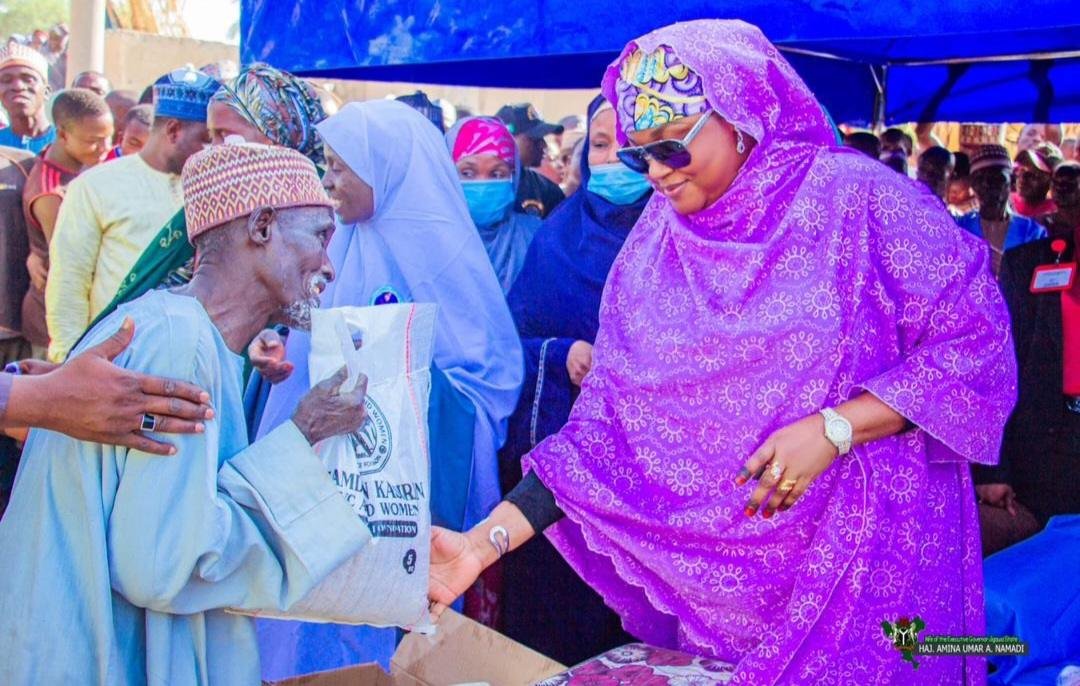
To understand the legacy of Hajiya Amina is to look into the eyes of the thousands she has touched. Her compassion is not a seasonal event; it is a permanent infrastructure. Through her Hamdan Kasiran OVC and Women Assistance Foundation, she has moved beyond the “handout” culture to create a “hand-up” economy.
Her work in the Tsangayar Rama community remains a focal point of her burgeoning legacy. In a move that stunned political observers, she bypassed the comfort of the capital to personally deliver aid and hope to a community of ten thousand that had long felt invisible. This is her hallmark: she does not wait for the vulnerable to find her; she seeks them out in the trenches of their need.
The Silent Partner in the Greater Jigawa Vision
While Governor Malam Umar Namadi drives the state’s 12-point agenda with administrative precision, Her Excellency provides the heartbeat that brings those policies to life. She has seamlessly aligned her philanthropic mission with the Governor’s goals of human capital development.
Understanding that a child’s education is often tied to a mother’s pocketbook, she has championed Economic Inclusion as a shield against the out-of-school children crisis. By facilitating entrepreneurship training and overseeing the disbursement of millions in grants to small-scale female traders, she is systematically eradicating “maternal poverty.” Her legacy will be a generation of Jigawa women who are no longer just survivors, but stakeholders in the state’s prosperity.
The Uniqueness of Her Spirit
What truly sets Her Excellency apart—and what will surely meet her approval—is the celebration of her uniqueness. In a world of artifice, she is authentically simple. She possesses a rare, easy-going nature that makes the beggar feel like a king and the orphan feel like a son.
Whether she is leading a Breast Cancer Awareness march through the streets of Dutse or launching the MAMII health program to protect pregnant women, she does so without the air of a superior, but with the warmth of a sister. This approachability has made her the ultimate role model for the modern Jigawa woman, proving that one can be powerful without being loud, and influential without being imposing
A Vision for the Future
As the Garkuwar Matan Africa (Shield of African Women), her advocacy for the Special Seats Bill and female education has positioned her as a progressive voice for the entire North. She is teaching the girls of Jigawa that their dreams are not limited by their geography, but fueled by their character.
Hajiya Amina Umar Namadi is not just building projects; she is building people. Her legacy is the widow who now owns a shop, the orphan who now wears a school uniform, and the woman who now believes her voice matters in the halls of power.
In the annals of Jigawa’s history, many will be remembered for the roads they paved, but Hajiya Amina will be remembered for the lives she mended. She remains a beacon of hope—a woman of substance, a partner in progress, and the gentle soul who turned the Government House into a home for all.
Ultimately, the story of Hajiya Amina Umar Namadi is more than a chronicle of philanthropic deeds; it is a testament to the enduring power of a leader who leads with her soul. In an era where leadership is often defined by distance, she has chosen proximity, making herself the bridge that connects the aspirations of the grassroots to the corridors of power. As she continues to walk side-by-side with Governor Malam Umar Namadi in the journey to build a “Greater Jigawa,” her footprint is unmistakable—not in the shifting sands of politics, but in the stable foundations of the lives she has transformed. She remains the state’s most profound symbol of dignity and grace, a role model whose legacy will be spoken of for generations to come. In Hajiya Amina, Jigawa has found not just a First Lady, but a mother whose heart is large enough to shelter an entire people, and a light that ensures no woman or child is ever left in the shadows.
Buhari Muhammad
Writes from Birnin kudu, Jigawa state.
Bkdjgs@gmail.com