By Ibrahim Muhammad
As the rising cost of Liquefied Petroleum Gas (LPG) continues to strain household budgets across Nigeria, many residents of Jigawa State are turning to briquettes made from agricultural waste as a cheaper and environmentally friendly alternative to cooking gas and firewood.
The transition is being driven by the Waste-to-Wealth Project, an initiative of the Exceptional Leadership and Integrity Promotion Initiative (ELIP) supported by the Partnership for Agile Governance and Climate Engagement (PACE), a programme funded by the United Kingdom Government.
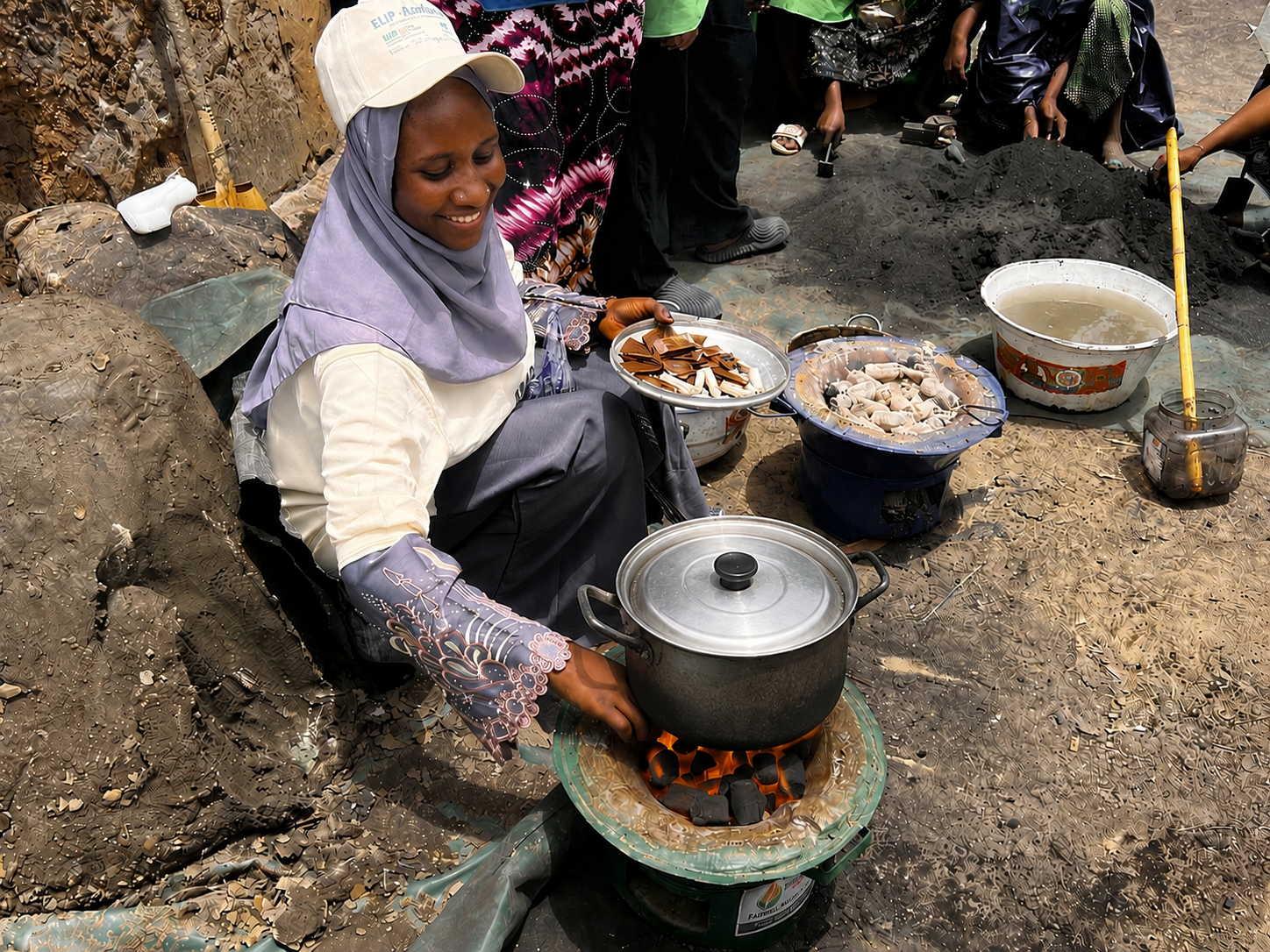
The project converts agricultural residues such as rice husks and invasive typha grass into clean energy briquettes while also producing energy-efficient cookstoves from locally sourced clay.
For many households struggling with the increasing cost of cooking fuel, the briquettes have emerged as a practical solution that offers affordability, accessibility and environmental benefits.
Malama Hauwa Ibrahim, a mother of five from Ringim, who said the briquettes and clean cookstove have significantly reduced her household cooking expenses.
“Before now, I relied mainly on firewood and sometimes cooking gas, but both became expensive and difficult to maintain. Since I started using the briquettes, I spend far less on cooking fuel,” she said.
According to Hauwa, the briquettes burn for a longer period and generate steady heat, making cooking easier and more economical.
“The clean stove is also very efficient. It uses less fuel and produces less smoke compared to traditional stoves. My kitchen is cleaner and I no longer experience the discomfort caused by excessive smoke while cooking,” she added.
Another beneficiary, Aisha Muhammad from Kiri Kasamma Local Government Area, described the initiative t as life-changing for her family.
She explained that the rising cost of LPG had forced her household to depend on firewood, which was becoming increasingly difficult and costly to obtain.
“When I was introduced to the briquettes, I was surprised by how effective they were. They ignite easily, cook food faster and last longer than ordinary firewood,” Aisha said.
She noted that the improved cookstove has further enhanced fuel efficiency by reducing the quantity of briquettes required for daily cooking.
“With the clean stove, I use fewer briquettes to prepare meals for my family. It saves money and time. The smoke is minimal and the cooking process is much more convenient,” she said.
ELIP Executive Chairman and Project Manager, Comrade Isah Mustapha, said the initiative was designed to address multiple challenges facing communities, including energy poverty, unemployment and environmental degradation.
According to him, the project has trained more than 120 women and youths drawn from Dutse, Ringim and Kirikasamma Local Government Areas in briquette production and clean cookstove fabrication.
“What started as a climate intervention has evolved into a livelihood programme that is creating jobs, generating income and improving access to affordable energy,” he said.
The project has established six community production centres located in Baranda and Sakwaya communities of Dutse Local Government Area, Kiri Kasamma and Turabu in Kirikasamma Local Government Area, as well as Ringim and Dabi in Ringim Local Government Area.
The centres serve as hubs for production, innovation and entrepreneurship, providing trained beneficiaries with equipment and starter kits to sustain their businesses.
Speaking on the broader significance of the project, the National Team Lead of FCDO-PACE, Ifeanyi Peters Ugwuoke, said the initiative demonstrates how communities, government and development partners can collaborate to address climate vulnerabilities while creating economic opportunities.
He noted that the project would contribute to reducing carbon emissions, combating deforestation, supporting sustainable livelihoods and strengthening climate resilience in vulnerable communities.
According to him, the initiative offers a practical model for integrating climate action with poverty reduction and economic development.
The initiative further tackles the growing challenge posed by typha grass, an invasive plant linked to blocked waterways, flooding and environmental degradation in parts of northern Nigeria.
The Jigawa State Government has also expressed strong support for the project.
Representing Governor Umar Namadi during the media launch of the initiative, the Commissioner for Power and Renewable Energy, Engr. Surajo Musa, described the project as proof that sustainable development can be achieved when communities are empowered to utilize resources available within their environment.
He said the state government views the Waste-to-Wealth initiative as an important component of its renewable energy and environmental sustainability agenda.
In recognition of its impact, Governor Umar Namadi has pledged to expand the programme to more local government areas and wards across the state. The governor also reaffirmed his administration’s commitment to supporting policies and partnerships that promote clean energy adoption, environmental sustainability and economic empowerment.
The growing acceptance of briquettes among Jigawa residents highlights the potential of locally driven solutions to address energy challenges while creating jobs and protecting the environment.