
By Ibrahim Ibrahim
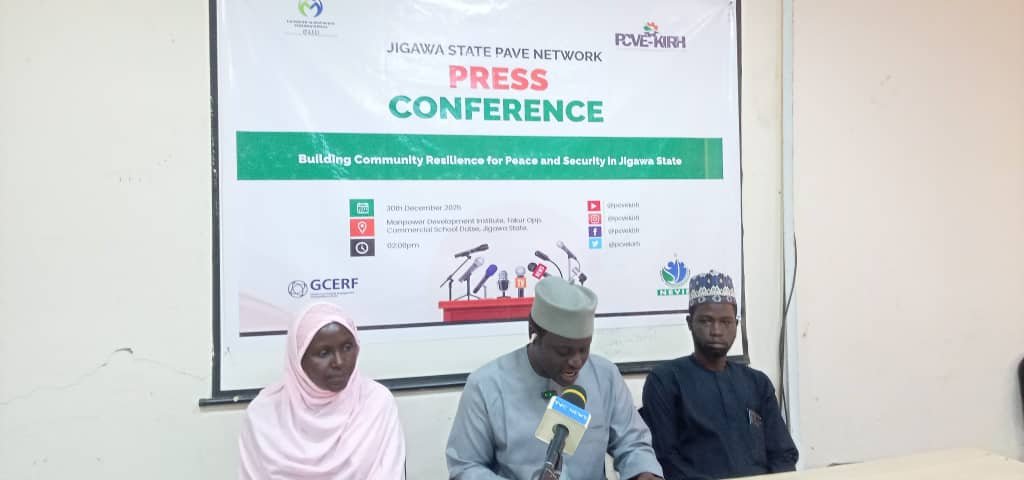
The Partnership Against Violent Extremism (PAVE) Network, Jigawa State Chapter, has urged residents of the state to see peace and security as a collective duty, warning that violent extremism can only be prevented through unity, vigilance and strong community involvement.
PAVE Chairman of the Network, Comrade Musbahu Basirka, stated this while Speaking at a press conference in Dutse on Tuesday.
He advised Jigawa residents not to take peace for granted, saying that the state has enjoyed relative calm compared to some neighbouring states’ developments across the North-West.

According to him, the region continues to face complex security challenges such as violent extremism, banditry, kidnapping and organised criminal activities, worsened by porous borders and economic hardship.
“Even though Jigawa is stable, we are part of a region where insecurity is evolving. That means everyone, government, communities, families and individuals must remain alert and committed to peace,” Basirka said.
He explained that studies and field experience have shown that factors such as youth unemployment, rural poverty, weak community early warning systems and the presence of armed groups make young people especially vulnerable to extremist influence.

Basirka stressed that relying on security forces alone is not enough to address these problems.
“Peace cannot be achieved by security agencies alone. It must be built from the community level, through inclusion, dialogue and opportunity,” he noted.
The PAVE chairman said the Network has been working closely with government institutions, security agencies, traditional leaders, civil society organisations, women and youth groups to strengthen structures for preventing and countering violent extremism in Jigawa State.
He revealed that Technical Working Groups have been trained and activated to develop State and Local Action Plans on Preventing and Countering Violent Extremism (PCVE), while sensitisation programmes have helped communities better understand the causes of extremism and how to prevent it.
Commending the Jigawa State Government, Basirka said its openness to engagement and gradual inclusion of PCVE priorities in planning and budgeting processes shows commitment to long-term peace.

One of the key achievements, he said, was the implementation of 15-day community resilience campaigns in selected local government areas, where residents were engaged on peace education, tolerance and how to resist extremist narratives.
“These interactions showed that communities are willing to take responsibility for their own safety when they are informed and involved,” he said.
Despite the progress, Basirka acknowledged that challenges remain, including youth unemployment, lingering insecurity in neighbouring states and weak information-sharing at the local government level.
He therefore called on residents to remain vigilant and support community alert systems, urged traditional and religious leaders to continue promoting peaceful coexistence, and encouraged young people and women to take the lead in positive storytelling and resilience-building activities.
He also appealed to local governments and MDAs to make PCVE part of their everyday planning, while calling on security agencies to strengthen trust with communities while respecting human rights.
Basirka concluded by reaffirming the PAVE Network’s commitment to working with all stakeholders, describing peace not as an abstract idea but as a shared responsibility that begins in homes, schools and neighbourhoods across Jigawa State.