By Ibrahim Ibrahim
Residents of Jigawa State have expressed deep concern over the rising spate of road traffic accidents that have claimed at least 38 lives within four days, calling for the immediate revival of the transport policy introduced under the administration of former Governor Sule Lamido.
The calls followed three separate accidents recorded in Ringim and Dutse Local Government Areas, which left dozens dead, several others injured, and properties worth millions of naira destroyed.
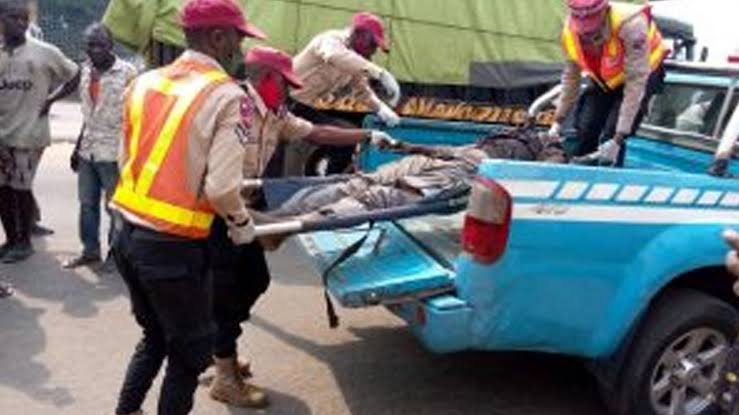
On Friday, no fewer than 11 persons reportedly lost their lives, while 12 others sustained varying degrees of injuries in a crash along the Ringim–Sankara–Beguwa Road. The accident involved a Volkswagen Golf conveying about 23 passengers. Preliminary investigations by the Federal Road Safety Corps (FRSC) attributed the crash to overloading and excessive speeding, which led to a tyre burst and loss of control.
Barely two days earlier, another fatal accident in Dutse Local Government Area claimed 22 lives when a trailer conveying sand collided with two Gulf vehicles transporting passengers to a wedding ceremony along the Kwanar Huguna–Dutse Municipal Road. The police confirmed the incident, adding that several others were injured.
In a related development, five members of the same family were killed in a lone accident at Bandawa village in Ringim LGA when a vehicle reportedly veered off the road while trying to avoid a goat and crashed into a tree. Two other occupants survived with injuries and are currently receiving medical attention.
Reacting to the tragic incidents, residents described the frequency of accidents as alarming and unacceptable. They noted that Jigawa State is blessed with relatively good road infrastructure, but blamed human factors—particularly reckless driving, speeding, and overloading—for the deadly crashes.
A Dutse resident, Malam Muntari, said it was painful that lives were being lost on roads that are in good condition.
“The problem is not the roads; it is the drivers. Some load vehicles beyond limit and still drive at high speed,” he said.
Other residents condemned the widespread practice of conveying passengers alongside heavy goods, describing it as dangerous and irresponsible.
“It is quite unfortunate that the boot of a car meant for goods has become a permanent seat for four passengers in Jigawa State, while goods are loaded on top,” a resident lamented.
“A single commercial vehicle now carries eleven or twelve fully grown passengers—three in the front, four at the back, and another four in the boot. If they have children, they are also squeezed in.”
They appealed to the FRSC, the police, and other relevant agencies to intensify enforcement of traffic laws and punish violators to serve as a deterrent.
The residents also urged the state government to revive the stricter transport policies introduced during the administration of former Governor Sule Lamido, which they said helped to reduce road casualties.
“During Sule Lamido’s administration, commercial vehicles were restricted to four passengers—one in the front seat and three at the back,” a resident recalled. “That policy saved many lives. If it is brought back and properly enforced, drivers will think twice before overloading.”
They further called on passengers to support efforts against overloading and overspeeding by refusing to board overloaded vehicles, stressing that collective responsibility is key to curbing the rising tide of road accidents in the state.